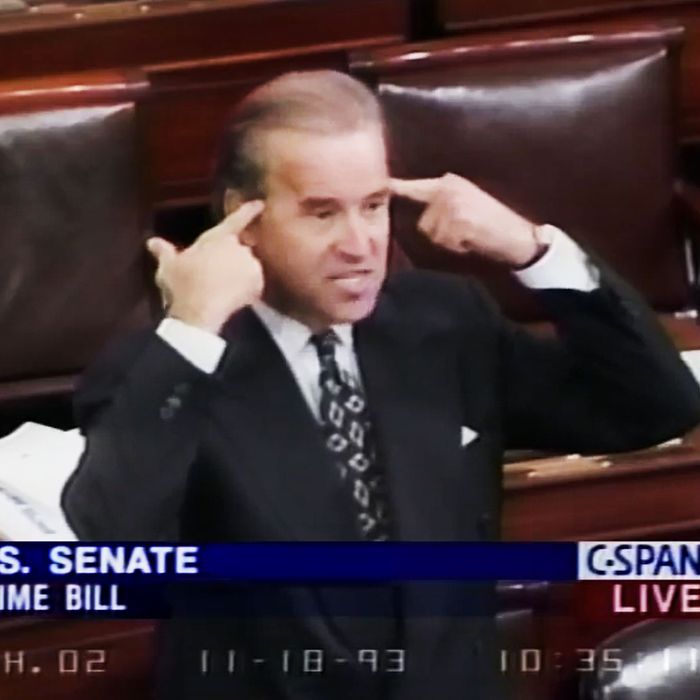
rather vote for person who tried getting me thrown in jail
then one that wants white supremacy and the extinction of my race I aint living these last 4 years again ... if thats what you're into

accept that you would rather lose than lose to feel right
i'll do the age old trash argument for you : what have YOU done for the people

you gonna vote for the KKK and be sanctioned off with cuts and treated like a fukking slave? family shot like small game? thats the hill you want to die on? imagine complaining on the internet like that's the answer.... when you're living that right now in 2020. I'd much rather take pandering and carrot dangling over actual white supremacy and terroristic, religious zealots. White people know they are cornered and are trying to turn into Medicaid GI Joe's ... I aint feeding into that. Imagine voting for a dude with KKK ties that hides in the floor when shyt gets thick
Will Black Voters Still Love Biden When They Remember Who He Was?
By
Eric Levitz@EricLevitz
Joe Biden once called state-mandated school integration “
the most racist concept you can come up with,” and Barack Obama “
the first sort of mainstream African American who is articulate and bright and clean.” He was a staunch opponent of
“forced busing” in the 1970s, and
leading crusader for mass incarceration throughout the ‘80s and ‘90s. Uncle Joe has described African-American felons as
“predators” too sociopathic to rehabilitate — and white supremacist senators a
s his friends... .
Biden helped kill the most effective policy for improving black educational attainment that America has ever known.
Joe Biden was for desegregating America’s schools, until his constituents were against it. When the Delaware Democrat launched his first campaign for the Senate in 1972, the Supreme Court had just ruled that the Constitution required policymakers to pursue “the greatest possible degree of actual desegregation” — and that forcing white students to attend schools in black neighborhoods, and vice versa, was a legitimate means of doing so. Being an enlightened liberal, Biden began his candidacy as an advocate for such policies. He accused Republicans of demagoguing the busing issue, and appealing to white voters’ ugliest instincts.
But as his campaign progressed, and Biden discerned that the arc of history was bending toward white backlash, the young candidate bent with it. He became a caricature of a white northern liberal —
arguing that forced busing was appropriate for the South (where segregation was the product of racist laws), but unnecessary for the North (where, Biden pretended, it merely reflected the preferences of the white and black communities).
Once in the Senate, Biden continued to triangulate, voting for most, though not all, f the anti-busing amendments that came before him. But for his overwhelmingly white constituents, nothing less than massive resistance to busing would suffice. The New Castle County Neighborhood Schools Association
booed Biden off the stage at one event in 1974. One year later, the Delaware senator broke ranks with northern liberals— and joined his virulently racist North Carolina colleague Jesse Helms in voting to kneecap all federal efforts to integrate schools, anywhere in the country. Specifically, Biden voted to bar the Department of Health, Education, and Welfare from requiring schools to provide information on the racial makeup of their student bodies — thereby making it nigh-impossible for Uncle Sam to withhold federal funds from school districts that refused to integrate.
The historian
Jason Sokol writes:
Immediately after the Helms amendment was tabled, Biden proposed his own amendment to the $36 billion education bill, stipulating that none of those federal funds could be used by school systems “to assign teachers or students to schools … for reasons of race.” His amendment would prevent “some faceless bureaucrat” from “deciding that any child, black or white, should fit in some predetermined ratio.”
…
Like the Helms gambit, [Biden’s provision] would still gut Title VI of the Civil Rights Act. But this time, a number of liberal senators that had opposed Helms’s amendment now supported Biden: Warren Magnuson and Scoop Jackson of Washington, where Seattle faced impending integration orders; and Thomas Eagleton and Stuart Symington of Missouri, where Kansas City confronted a similar fate. Mike Mansfield, the majority leader from Montana, also jumped on board. Watching his liberal colleagues defect, Republican Jacob Javits of New York mused, “They’re scared to death on busing.” The Senate approved Biden’s amendment. Biden had managed to turn a 48-43 loss for the anti-busing forces into a 50-43 victory.
The NAACP called Biden’s proposal “an anti-black amendment.” The Senate’s sole African-American member, Ed Brooke, called it “the greatest symbolic defeat for civil rights since 1964.” But Biden helped his fellow liberals reconcile themselves to the wrong side of history by recasting integrationists as the real racists... .
Biden worked tirelessly, over several decades, to make America’s (profoundly racist) criminal-justice system more punitive than any other advanced democracy’s.
It is hard to name an infamously unjust feature of America’s criminal-justice system that Joe Biden didn’t help to bring about. Mandatory minimum sentences for nonviolent drug offenders, the sentencing disparity between crack and powder cocaine, civil asset forfeiture, and extensive use of the death penalty — the Delaware senator was involved in establishing them all.
Biden is famous for his lead role in crafting the 1994 crime bill, or, as the senator preferred to call it (as recently as 2015), the “1994 Biden Crime Bill.” Some aspects of that legislation remain popular within the Democratic Party — among them, the Violence Against Women Act, a federal assault-weapons ban, and funds for “community oriented” policing. But in 2019 America — a place where our nation’s violent crime rate is near historic lows, while its incarceration rate hovers around world-historic highs — the bill’s broader legacy is ignominious. The Brennan Center
succinctly summarized that legacy on the 20th anniversary of the bill’s passage:
It expanded the death penalty, creating 60 new death penalty offenses under 41 federal capital statutes. It eliminated education funding for incarcerated students, effectively gutting prison education programs. Despite a wealth of research showing education increases post-release employment, reduces recidivism, and improves outcomes for the formerly incarcerated and their families, this change has not been reversed.
And the bill created a wave of change toward harsher state sentencing policy. That change was driven by funding incentives: the bill’s $9.7 billion in federal funding for prison construction went only to states that adopted truth-in-sentencing (TIS) laws, which lead to defendants serving far longer prison terms. Within 5 years, 29 states had TIS laws on the books, 24 more than when the bill was signed. New York State received over $216 million by passing such laws. By 2000 the state had added over 12,000 prison beds and incarcerated 28 percent more people than a decade before.
As a result of these policies — and many others — the United States imprisons a higher proportion of its population today than any other developed country. This is not because Americans commit more crimes — victimization rates in the United States are comparable to those in Western Europe. Rather, it is because we impose harsher sentences on convicts than any other nation deems conscionable.
...
During the 1980s, Biden helped pass laws reinstating the federal death penalty, abolishing federal parole, increasing penalties for marijuana possession, expanding the use of civil asset forfeiture, and establishing a 100-to-1 sentencing disparity for possession of crack cocaine (used disproportionately by poor nonwhite people) and powder cocaine (used disproportionately by rich white people)... .
...
Beyond his role in perpetuating systemic racism (through his opposition to school integration, and support for mass incarceration), Biden has long displayed a penchant for political incorrectness. His suggestion that Barack Obama was the first clean and articulate African-American to run for president is probably the most infamous of his gaffes. But the former vice-president also told a crowd of black voters in 2012 that Mitt Romney would “put you all back in chains,” ... .
I’ve been around so long, I worked with James Eastland,” Biden
said at a rally for Democratic Senate candidate Doug Jones in the fall of 2017. “Even in the days when I got there, the Democratic Party still had seven or eight old-fashioned Democratic segregationists. You’d get up and you’d argue like the devil with them. Then you’d go down and have lunch or dinner together. The political system worked. We were divided on issues, but the political system worked.”
Biden’s sentiments read like a satire of nostalgia for bipartisan comity, laying bare the amorality and elitism inherent to celebrating collegiality for its own sake.
Needless to say, a political system in which a man who believed that his dark-skinned constituents belonged to an “inferior race” — and must be quarantined to their own institutions to prevent the “mongrelization” of the white race — was not one that “worked” for said constituents.
And Eastland isn’t the only white supremacist Biden can’t help expressing grudging admiration for. The Democratic front-runner also warmly eulogized Strom Thurmond at his funeral, and his insistence on fondly recalling his relationship with Jesse Helms “grates on even members of his own team, who have told him as much,” according to a recent report from the New York Times.
Biden’s faith in such senators’ entitlement to dignity, and capacity for redemption, stands in marked contrast to his erstwhile views on rehabilitating “predators” and “violent thugs.”... .
...One answer is the Biden’s apparent strength with such voters is illusory. The (likely) candidate is coasting off of his name recognition and association with Barack Obama. Once the primary campaign puts the history summarized above under the spotlight — along with Biden’s myriad other heresies against progressivism, including his
support for bankruptcy reforms that hurt low-income consumers, his shoddy treatment of Anita Hill, and his advocacy for the Iraq War — black voters will see through his “malarkey.” This is quite plausible... .
Will Black Voters Still Love Biden When They Remember Who He Was?






 These are the fanatical ramblings of a democrat religious zealot

 but he's a damn good business manager. I know a Sudanese breh that is great with coding and troubleshooting. Do I not bring them into the fold because they gay or not ADOS?