
Bigblackted4
Superstar
What was this supposed to signify brother


What was this supposed to signify brother


Very obviousIdk if they are getting state department cash but white supremacist billionaires are definitely funding their stuff
Threads like this reveal who are adjacent and tethered to white supremacy.If you need someone to convince you not to be a useful idiot for cac racists then consult your family.
Looking for admonishing??Clearly the point is over your head but *looks at username* this was to be expected
He should have addressed the "millions of years indigenous history in the Americas", instead of Africa he claims Black Americans have no connection to.What was this supposed to signify brother

I’m basic educated in actual history, not fantasy babble. Dwann B and you are pretendians, self proclaimed color coppered Indians!
Meanwhile you have an Italian man claiming jazz came from Italians, but with thy your dumbass has no issues.
I made a thread about it / him.

Nick LaRocca & The Original Dixieland Jazz (Jass) Band (ODJB) Recording Tiger Rag in 1917
The channel owner claims that Jazz originated with Italians. And that the word Jazz stems from a Sicilian word “jass”. From the channel: “In this episode of Celebrating Culture: Bandleader David Hansen speaks with Charles Marsala about the "Father of Modern Jazz", Sicilian Cornetist &...
"In Haiti they won autonomy; in the United States they fled from the slave states in the South to the free states in the North and to Canad.
Here the Free Negroes helped form the Abolition Movement, and when that seemed to be failing, the Negroes began to plan for migration to Africa, Haiti and South America."
Dr. John Henry Clark - Collected Writings
https://raggeduniversity.co.uk/wp-c...ritings-Of_-John-Henrik-Clarke_compressed.pdf

Afriqua Presents Principles of Black Music: Call & Response
Afriqua’s essay series on the Principles of Black Music examines Call & Response and the participatory nature of music-making with African rootswww.ableton.com

Black History Month: African American music has deep roots and strong branches – Jackson Advocate
During the flush days of the “Black Power” movement and the “Black is Beautiful” era, more than a few credible anthropologists made the discovery thatjacksonadvocateonline.com
Call-and-response has very deep roots, and its origin is African — long predating Christianity, gospel music, or Western hymn traditions.
Here is a clear explanation:
Origin of Call-and-Response
1. West and Central African musical traditions
Call-and-response is a core feature of traditional African music, especially among cultures in:
In these traditions:
- West Africa (Yoruba, Akan, Igbo, Mande, Wolof, etc.)
- Central Africa (Kongo, Luba, etc.)
This structure appears in:
- A leader sings or chants a phrase (the call).
- The community responds with a repeated or complementary phrase (the response).
- It reinforces community participation, rhythm, and shared identity.
It is thousands of years old.
- work songs
- dance ceremonies
- religious rituals
- storytelling
- drumming ensembles
2. How it came to the Americas
Enslaved Africans brought call-and-response directly to:
Because enslaved people were often prevented from using drums or instruments, they adapted the tradition vocally:
- the Caribbean
- Brazil
- the United States
This preserved African rhythm and social structure even under oppression.
- work songs on plantations
- field hollers
- ring shouts
- early spirituals
3. Influence on African-American music
Call-and-response became the foundation of:
In Black churches, the preacher–congregation dynamic (“Can I get an amen?”) is a direct continuation of this African structure.
- spirituals
- blues
- gospel
- jazz
- soul
- funk
- hip-hop (MC → crowd responses)
4. How it shaped “Amazing Grace”
When African-American communities sang hymns like Amazing Grace, they naturally incorporated:
This is why the gospel versions sound so different from the original 18th-century English hymn.
- leader vs. congregation lines
- echoing phrases
- improvised responses
- rhythmic interaction
If you want, I can also explain:
- how call-and-response works musically
- examples from specific African ethnic groups
- or how it evolved into hip-hop and modern R&B.
You and Dwann are not the color coppered Indians they talked about.
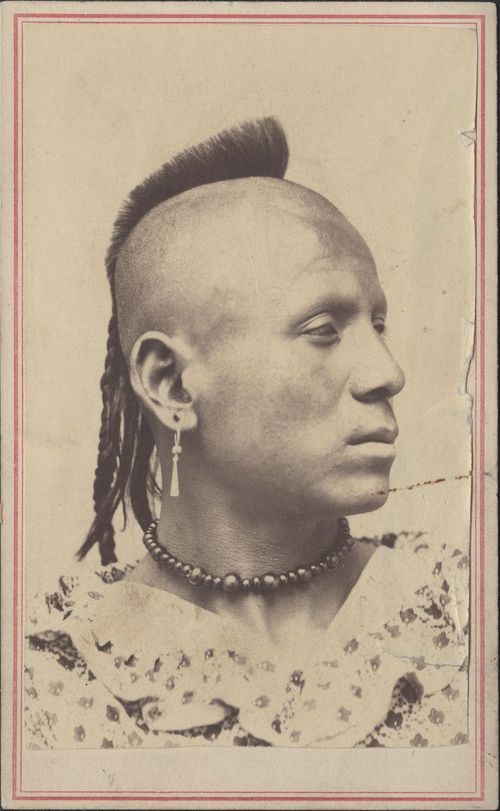
"They go completely naked except that around their loins they wear skins of small animals like martens, with a narrow belt of grass around the body, to which they tie various tails of other animals which hang down to the knees; the rest of the body is bare, and so is the head.
Some of them wear garlands of birds’ feathers. They are dark in color, not unlike the Ethiopians, with thick black hair, not very long, tied back behind the head like a small tail".
"The Written Record of the Voyage of 1524 of Giovanni da Verrazano as recorded in a letter to Francis I, King of France, July 8th, 1524

Osage Tribe in Jackson County — JCHS
www.jchs.org

Ancient DNA From Frozen Hair May Untangle Roots
https://www.science.org/doi/10.1126/science.320.5880.1146b
“We’ve blogged about EDAR before; Could it be hair form?, EDAR controls hair thickness and EDAR and hair thickness. The story here is simple, before the populations ancestral to the Native Americans had left eastern Asia a mutation on the EDAR gene swept nearly to fixation among these populations. The derived SNP in particular is correlated with the thicker hair typical of East Asians and Native Americans.”
https://www.gnxp.com/WordPress/2008...east-asians-native-americans-have-thick-hair/
“Most people of East Asian descent have thick, straight hair. This corresponds with a SNP (rs3827760) in the EDAR gene which is involved in hair follicle development. The ancestral allele of this SNP is the A-allele. The G-allele is the newly derived allele that leads to the thick, straight hair. In certain parts of Asia, almost all people have the G-allele (see Fig.1B). People with the GG genotype at this SNP have thicker hair compared to those with the AA genotype due to the modification of a single amino acid in the protein. Those with the AG genotype have hair slightly thinner than those with GG, but still thick when compared to Europeans and Africans (likely AA) [2, 3].
A recent genome wide association scan has found a SNP (single nucleotide polymorphism) called rs11803731 in the TCHH gene which accounts for about 6% of hair curliness. The TCHH gene encodes a protein called trichohyalin, which is known to be expressed at high levels in hair follicles and has been shown to be involved in the cross-linking of the keratin filaments found in hair. The ANCESTRAL allele of this SNP (the A-allele) is present in the worldwide population. Sometime during human history, a mutation lead to the emergence of the T-allele (called the derived allele in Fig. 1A). The T-allele causes an amino acid to change from leucine to methionine at position 790 of the TCHH gene.”
The adaptive variant EDARV370A is associated with straight hair in East Asians - PubMed
“Shovel shape of upper incisors is a common characteristic in Asian and Native American populations but is rare or absent in African and European populations. Like other common dental traits, genetic polymorphisms involved in the tooth shoveling have not yet been clarified. In ectodysplasin A receptor (EDAR), where dysfunctional mutations cause hypohidrotic ectodermal dysplasia, there is a nonsynonymous-derived variant, 1540C (rs3827760), that has a geographic distribution similar to that of the tooth shoveling. This allele has been recently reported to be associated with Asian-specific hair thickness.”
[…]
In Asian and Asia-derived populations, dental variations have often been described as “Sinodonty” and “Sundadonty.” Sinodonty, common among East Asian and Native American populations, is a combination of dental characteristics that relatively often include upper first and second incisors (UI1 and UI2) that are shovel-shaped and not aligned with the other teeth, upper first premolars (UP1) with one root, and lower first molars (LM1) with three roots”
A Common Variation in EDAR Is a Genetic Determinant of Shovel-Shaped Incisors


u can get the fukk outta here with that African shyt …. ADOS/FBA accomplishment have nothing to do with that place

 adamhudson.org
 www.jstor.org


 artsandculture.google.com


 surinameafricanheritage.wordpress.com


