An alternative to Tommy John surgery? Royals’ Jesse Hahn returns to majors after having new UCL-repair procedure
By Alec Lewis Sep 3, 2019
35
In August 2018, right-handed pitcher Jesse Hahn hopped in his car and drove across Missouri, from Kansas City to the St. Louis area. It was morning when the journey began; the sun was shining, and the interstate was relatively empty. On his mind was the next morning’s appointment with well-known orthopedic surgeon Dr. George Paletta, whose diagnosis had the potential to change Hahn’s baseball life.
The Kansas City Royals had scheduled the appointment for Hahn after months of failed attempts to heal his injured right elbow. Hahn had tried simple rest. He had tried therapy work. Doctors had even given him an injection. But the razor-sharp pain had persisted throughout. Seeing Paletta, the medical director/head team physician for the St. Louis Cardinals from 1998 to 2013 and then an orthopedic surgeon for the team, to assess surgery possibilities was (and usually is) the last resort.
During the afternoon and evening leading up to the next morning’s appointment, Hahn had flashbacks of the Tommy John surgery he had undergone in 2010. But by the time he walked into the Orthopedic Center of St. Louis in Chesterfield, Mo., he had a clear and open mind.
Hahn had already undergone MRIs in Kansas City, and the outlook was not great.
“His MRI showed the graft had torn right off the humerus bone,” Paletta says, “which is the most common place a reconstruction can re-tear.”

MCLI@TheMCLI
Dr George Paletta, St Louis Cardinals Orthopedic Surgeon, performs a "Tommy John" surgery in our Surgical Skills Lab.

2
10:42 AM - Feb 25, 2017
Twitter Ads info and privacy
Typically, Tommy John surgery is required for a diagnosis such as this one, requiring the athlete to rehab for more than a year and in some cases for 17 or 18 months. Hahn was 29 and felt he did not have the kind of time to put forth that effort again. Hence the reason he was there.
Perhaps there was an alternative?
A select few doctors had performed a new procedure in recent years called “primary repair with internal brace,” which involves repairing the ligament with strong sutures that serve as a scaffold and can cut the Tommy John surgery rehab time in half. The only current professional pitcher reported to have undergone the operation is Texas Rangers minor leaguer Seth Maness. As Hahn was aware, Paletta had performed that surgery.
After looking at the MRIs, Paletta sat in the room and told Hahn he could be a candidate for the procedure, but the surgeon wouldn’t know for sure until he digs into the patient’s arm, makes an incision into the ligament and dissects the tissue. Hahn, wanting to pitch again in the majors for those family and friends who have followed this career and for his own love of the game, agreed to sign a waiver, allowing Paletta to operate on his arm days later in the best way Paletta saw fit.
“Whatever was best for me, I wanted to have that done,” Hahn says. “When I woke up, I was going to deal with it.”
Jesse Hahn grew up in Groton, CT, a town along the Connecticut shoreline between New London and Mystic. His dad, Fred, played baseball as a youth, and Jesse followed suit. One year in Little League, Fred remembers, Jesse pitched six innings and recorded 18 strikeouts.
“You could almost see it then,” Fred says. “He was something a little special.”
A teammate named Matt Harvey felt that way as well. Harvey played alongside Hahn at Fitch Senior High School in Groton, and the two fed off each other. A number of scouts and coaches would come to Fitch to see Harvey, but also notice the lesser-known 6-foot-4, 170-pound kid named Hahn. The latter pitcher threw 40 innings in his senior year and went 5-1 with 65 strikeouts. More notably: He set a then-state record (minimum 35 innings pitched) with a 0.17 ERA.
Both picked Atlantic Coast Conference (ACC) schools, with Harvey headed to the University of North Carolina and Hahn choosing Virginia Tech. The two would face each other, Hahn thought. They’d continue to push each other, inspire each other. Not that Hahn needed much inspiration. His sister Melissa, who has cerebral palsy and followed his every outing, fueled him every day.
“If any kid had half the heart she has,” Fred says, “they’d be a major league pitcher.”
Being a major league pitcher was Hahn’s goal, but first he needed to pitch well in college. After posting a 4.64 ERA in nine starts as a freshman at Virginia Tech, he filled out, putting on 30 pounds. The Hokies elected to move Hahn to the closer role his sophomore season, but he struggled to command his pitches. That summer (in 2009), he pitched in the Cape Cod League. His velocity touched 100 mph. Before long, Hahn was being mentioned in the same breath as Chris Sale in terms of big league potential.

Patrick Mason@PatrickMason22
Baseball Night in Blacksburg 2/8 6-9pm auction
#TBRay & former
#Hokie Jesse Hahn signed & game worn Jersey
#hokieball
 https://twitter.com/intent/like?tweet_id=293741239281541120
8:25 AM - Jan 22, 2013
Twitter Ads info and privacy
https://twitter.com/intent/like?tweet_id=293741239281541120
8:25 AM - Jan 22, 2013
Twitter Ads info and privacy
Hahn’s climb up scouts’ rankings continued throughout his junior season, and many thought him to be a sure-fire first-round draft pick. Then came the first big obstacle: Hahn suffered an elbow injury late in the season. His draft stock fell. Still, the Tampa Bay Rays had enough confidence in Hahn’s future to select him with their sixth-round pick in the 2010 draft. They even paid him second-round money despite knowing he needed Tommy John surgery.
In July 2010, Dr. James Andrews performed the operation.
Tommy John surgery has been ingrained in the fabric of Major League Baseball since 1974, the year Dr. Frank Jobe first utilized the procedure on Dodgers left-handed pitcher Tommy John. But there’s a misconception about the operation and its beginnings. It wasn’t an immediate success.
During the course of his rehab, John’s left arm would sting with pain. He returned to Jobe, who determined another surgery would be necessary because scar tissue had grown over the ulnar nerve.
Jobe went in and cleaned up the area, but even he was skeptical John would be able to return.
“I didn’t do any more [surgeries] for two years to see how [John] came out,” Jobe said. “Then I started doing a few more. At that time, I thought I shouldn’t do this on anyone who’s going to be a pitcher, due to the year of rehab.”
John finally returned to pitching, and by the time he had won more games than he had prior to the surgery, the operation had become more widespread.
“From there, things kind of exploded,” says current orthopedic surgeon Dr. Jeffrey Dugas, who works with Andrews Sports Medicine in Birmingham, Ala.
According to Dugas, in 1992, Dr. John Conway, who was Jobe’s assistant during the beginnings of ulnar collateral ligament reconstruction, wrote the first academic article about Jobe’s first group of 70 athletes. Of them, 56 received full reconstruction surgeries. The other 14 received repairs, in which Jobe sewed the ligament back down and re-anchored it.
As has been written and published by Dugas, “only seven of the 14 of those who underwent repair were able to return to the same level of play,” compared to a nearly 75 percent return rate for those who underwent reconstructions.
“On the basis of that,” Dugas says, “Jobe rightfully concluded that repairs were a bad idea.”
In 1995, Dugas says, Andrews published a report confirming Jobe’s conclusion. So reconstruction surgery — Tommy John surgery — emerged as the primary option for athletes of all levels who suffered UCL tears. By 2010, Dr. Lyle Cain and Dugas had seen 1,281 reconstructions and concluded the procedure had a 75-92 percent rate of return to competition, which they outlined in a report with the American Sports Medicine Institute.

ASMI@ASMI_INFO
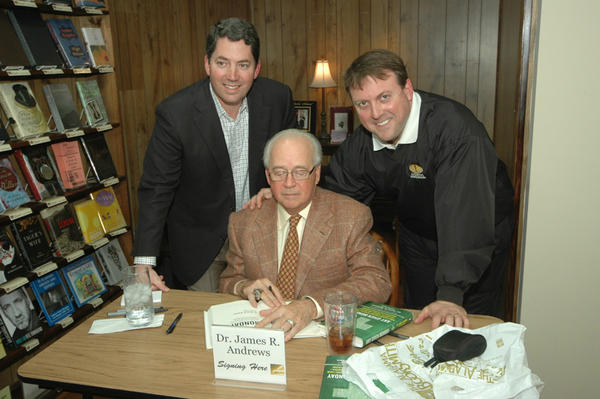
Dr. Lyle Cain, Dr. Jim Andrews, Dr. Jeff Dugas at the "Any Given Monday" book signing event Friday night
1
2:47 PM - Jan 14, 2013
Twitter Ads info and privacy
Having seen that quantity of UCL tears, Dugas also had another conclusion.
“Not all Tommy John injuries are the same,” he says. “You get some that are blown in half, and the tissue is just crap. And then you get injuries that you cut into the ligament, and you think, I’m not even sure I’m operating on the correct elbow. The spectrum is so vast.”
Fifteen years had passed since Jobe and Andrews’ conclusions. In that span, new technologies had permeated the medical field. There had been advances in suture material. There had been developments in biological additives such as collagen-dipped tape.
A number of orthopedic surgeons recognized what this might mean, including Dr. Felix “Buddy” Savoie, the Chairman of Orthopaedic Surgery at Tulane University.
In the mid-2000s, Savoie published an article in the American Journal of Sports Medicine about his having done a direct repair of the UCL using new technology, one with a high success rate and quick rehab times for athletes.
“Not a lot of people paid attention to that,” Dugas says.
But as time passed, Dugas thought more and more about possibly utilizing primary repair with an internal brace. At one point, he called Savoie to get his thoughts.
“What do you think about this option?” Dugas asked Savoie.
“Jeff, you’re on the right track,” Savoie said. “People don’t believe the outcomes we’re getting with this. If you add the internal brace, you’re changing the game.”
Dugas used primary repair with internal brace in a basic-science study on cadavers to confirm the idea that it could work as well as reconstructions had. In August 2013, he performed the first real operation.
By this time, Paletta had also begun utilizing this procedure, particularly on high school and college athletes who injured themselves late in their careers and wanted to come back and play their senior seasons. As Dugas saw positive results, he expanded his use of the operation to collegiate athletes and minor-league players.
“I could legitimately look them in the eye and say, ‘I’ve done enough of these that it’s successful and can work for you,’” Paletta says.
In 2016, Paletta viewed the medicals of major league pitcher Seth Maness. Maness had pitched well as a steady reliever for the St. Louis Cardinals. But early in 2016, his arm did not feel the same. Maness didn’t feel up to the arduous rehab process associated with Tommy John surgery. Paletta knew this, but he also knew the right-hander wouldn’t be able to avoid it if that was what was best for the patient.
Seth Maness, right, was a workhorse reliever for the Cardinals, making 215 appearances from 2013-15. (Jasen Vinlove/USA TODAY Sports)
Until Paletta saw the quality and quantity of tissue within Maness’ elbow, he could not tell Maness upfront what operation he would perform. Maness was OK with this. He signed the waiver and woke up as the first known big leaguer to have undergone the procedure.
“The decision to operate on Seth,” Dugas says, “it had to be the right person.”
Seven months after surgery, Maness was back throwing as hard as he had prior. The Royals signed him in 2017. Maness threw 9 2/3 innings that year and posted a 3.72 ERA (he has been in the minors since).
One year later, he met Jesse Hahn.

Kansas City Royals
✔@Royals
We’ve acquired pitchers Jesse Hahn and
@hfillmyer08 from the Oakland Athletics in exchange for Brandon Moss, Ryan Buchter and cash considerations.

688
5:22 PM - Jan 29, 2018
Twitter Ads info and privacy





 Glad he's getting a chance to play every day
 Those Phillies memes are really starting to be true.