"Blacks Are Stealing History" Egypt, Sumer, China, Maya etc etc

Deuterion

Superstar
Supporter
Joined
Apr 2, 2018
Messages
6,577
Reputation
3,640
Daps
41,476
Reppin
LBC
:patrice: Ppl keep saying this but the nubians, aka modern sudanese, are literally some of the darkest ppl on the planet. Their complexion is kinda their distinguishing feature, even among other Africans, so ofc the Egyptians noted it.

Nonetheless, ancient Egypt was peopled from the south, according to both the archaeology and their own words.

:jbhmm: Thinking about it, its similar to the difference btwn geechees and other sc ados. We all come from the same geechee root, just with varying levels of admixture.

It’s also like a Black Californian vs a Black New Yorker...just because one is Californian and one is a New Yorker doesn’t neglect the fact that we both Black. The distinction after Black just highlights the different cultural customs between us as Black people e.g. one of us most likely wears Northfaces and Timbs and one of us doesn’t.

The distinction between a Nubian and Kemite could have been that simple but it is lost due to the sheer amount of time and whites and Arabs.
 

Asante

All Star
Joined
Apr 3, 2014
Messages
1,868
Reputation
90
Daps
5,399
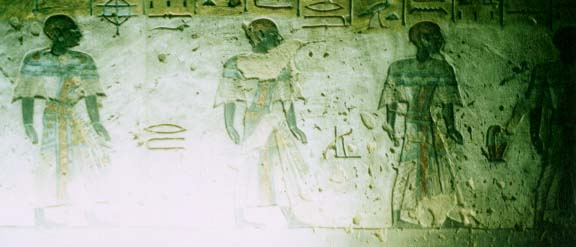
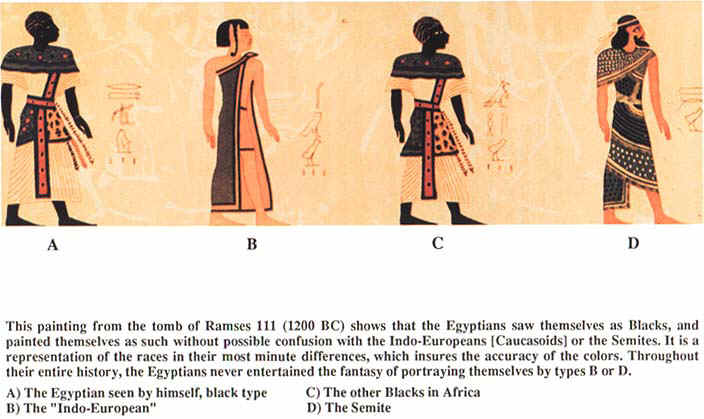
In those very same paintings they seem to distinguish themselves from the Nubians(who were black).
9569641685_f7b4c91fe7_b.jpg


This is how they most often depicted themselves

hornungdistortiongz4.jpg

4Rmt.jpg

Lepsius_4Groups.jpg


If the Egyptians were anything they were probably mixed, explained by the fact that they weren't only multicultural but also got conquered and ruled by several different civilizations (including Nubia).
Well when you say "Egypt" you're talking about a civilization that was named by the Greeks during the 4th century BC, so you may be correct, When you talk about Kemet however rest assured that it was entirely Black in it's inception.

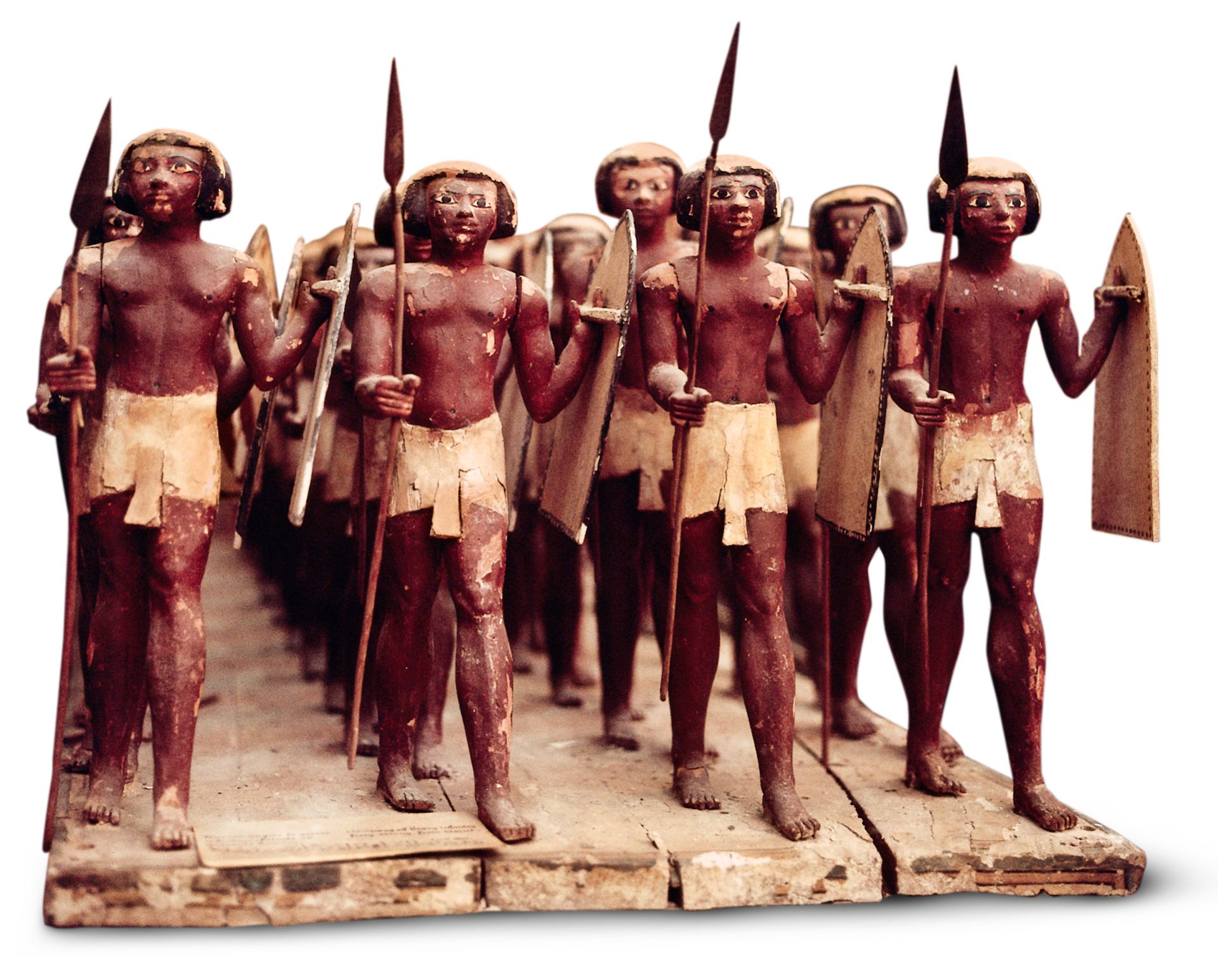
If Kemet was multi racial then why aren't their any non Black people in the army???????

MA_00452016_hhpwae.jpg
Kemet was a biologically and politically Black African nation. They literally barred white people from their land until the Late Period. The biological affinities of the ancient Kemites, showed that they were biological almost identical to certain Nubian populations.

"On this basis, many have postulated that the Badarians are relatives to South African populations (Morant, 1935 G. Morant, A study of predynastic Egyptian skulls from Badari based on measurements taken by Miss BN Stoessiger and Professor DE Derry, Biometrika 27 (1935), pp. 293–309.Morant, 1935; Mukherjee et al., 1955; Irish and Konigsberg, 2007). The archaeological evidence points to this relationship as well. (Hassan, 1986) and (Hassan, 1988) noted similarities between Badarian pottery and the Neolithic Khartoum type, indicating an archaeological affinity among Badarians and Africans from more southern regions. Furthermore, like the Badarians, Naqada has also been classified with other African groups, namely the Teita (Crichton, 1996; Keita, 1990).

Nutter (1958) noted affinities between the Badarian and Naqada samples, a feature that Strouhal (1971) attributed to their skulls possessing “Negroid” traits. Keita (1992), using craniometrics, discovered that the Badarian series is distinctly different from the later Egyptian series, a conclusion that is mostly confirmed here. In the current analysis, the Badari sample more closely clusters with the Naqada sample and the Kerma sample. However, it also groups with the later pooled sample from Dynasties XVIII–XXV.

The reoccurring notation of Kerma affinities with Egyptian groups is not entirely surprising. Kerma was an integral part of the trade between Egypt and Nubia.

However, the archaeological evidence actually showed slow change in form over time (Adams, 1977) and the biological evidence demonstrated a similar trend in the skeletal data (e.g. Godde, in press; Van Gerven et al., 1977). These conclusions negate the possibility of invasion or migration causing the shifts in time periods. The results in this study are consistent with prior work; the Meroites and X-Group cluster with the remaining Nubian population and are not differentiated."

-- Godde K. (2009) An Examination of Nubian and Egyptian biological distances: Support for biological diffusion or in situ development? Homo. 2009;60(5):389-404​
 
Last edited:

HarlemHottie

Uptown Thoroughbred
Joined
Jun 10, 2018
Messages
19,517
Reputation
12,944
Daps
81,305
Reppin
#ADOS
It’s also like a Black Californian vs a Black New Yorker...just because one is Californian and one is a New Yorker doesn’t neglect the fact that we both Black. The distinction after Black just highlights the different cultural customs between us as Black people.
:jbhmm: To continue the analogy, similar to your CA ados and NY ados, ancient Egyptians and nubians shared a similar base culture. We see this at Nabta Playa, officially dated to 7500 bc- the same special attention paid to certain stars, a cattle cult, and a predecessor to Hathor.

Nabta Playa - Wikipedia

To take it back to the OP, this is why those side by side comparisons matter. They indicate a broad cultural diffusion between ancient Egypt and west Africa. Which way this diffusion went, we do not yet know, but the dates are suggestive. I await new discoveries.

These are not my own opinions, though i agree enthusiastically. I was trained as a historian and keep up with current research when i can.
 

Budda

Superstar
Joined
Jun 12, 2013
Messages
10,781
Reputation
932
Daps
28,061
you should care. since it's you who's trying to connect the west african population to ancient egypt, when most west africans don't care

I've been in almost all the AE threads. That page you linked me do just isn't cutting it. it's not enough evidence to connect the two.

Most west Africans couldn’t tell you where they come from and are pretty uneducated on their ancient history for a reason, apart from Diop most of the scholarly work in these subjects have come outside of West Africa, what West Africans care about shouldn’t matter really.
 
Joined
May 3, 2012
Messages
54,655
Reputation
25,155
Daps
254,419
Reppin
St louis
Breh, this is false

Look at the whole north of Africa; Egypt, Algeria, Morocco, Libya and Tunisia and they are clearly paler, arab-like people

Considering Egypt is the nearest to the Middle East shouldn't be a surprise


the paler people there now are new jacks breh.
the only thing that seperated the Egyptians and jews
of moses time was the God concept/religion......they were all black.
moses passing for the son of pharoh is further proof.
it all leads back to Africa and it'll end there.
The middle east was black......everthing was.

UKVu0t8.gif
 

Losttribe

[Formerly Blackking]
Joined
Jan 14, 2016
Messages
5,458
Reputation
-765
Daps
10,685
Mummy DNA unravels ancient Egyptians’ ancestry

Genetic analysis reveals a close relationship with Middle Easterners, not central Africans.


Excavations in the ancient city of Abusir el-Meleq. Credit: Petr Bonek/Alamy
The tombs of ancient Egypt have yielded golden collars and ivory bracelets, but another treasure — human DNA — has proved elusive. Now, scientists have captured sweeping genomic information from Egyptian mummies. It reveals that mummies were closely related to ancient Middle Easterners, hinting that northern Africans might have different genetic roots from people south of the Sahara desert.

The study, published on 30 May in Nature Communications1, includes data from 90 mummies buried between 1380 BC, during Egypt’s New Kingdom, and AD 425, in the Roman era. The findings show that the mummies’ closest kin were ancient farmers from a region that includes present-day Israel and Jordan. Modern Egyptians, by contrast, have inherited more of their DNA from central Africans.

Archaeological discoveries and historical documents suggest close ties between Egypt and the Middle East, but “it is very nice that this study has now provided empirical evidence for this at the genetic level”, says evolutionary anthropologist Omer Gokcumen of the State University of New York at Buffalo.

Egypt’s searing climate and the ancient practice of embalming bodies has made the recovery of intact genetic material daunting. The first DNA sequences thought to be from a mummy2 were probably the result of modern contamination, and many scientists are sceptical3 of purported genetic information acquired from the mummy of King Tutankhamun4.

The latest analysis succeeded by bypassing soft tissue — often abundant in Egyptian mummies — to seek DNA from bone and teeth. Researchers carefully screened the DNA to rule out contamination from anyone who had handled the mummies since their excavation a century ago in the ancient town of Abusir el-Meleq.

“More than half of the mummies we studied had pretty decent DNA preservation,” says co-author Johannes Krause, a palaeogeneticist at the Max Planck Institute for the Science of Human History in Jena, Germany.

The team “succeeds where previous studies on Egyptian mummies have failed or fallen short”, says Hannes Schroeder, a palaeogeneticist at the University of Copenhagen. Now, researchers can hope to answer questions such as whether immigration drove ancient-Egyptian population growth, adds Sonia Zakrzewski, a bioarchaeologist at the University of Southampton, UK.

The scientists obtained information about variations in mitochondrial DNA, which is passed from mother to child, from 90 mummies. Because of contamination, the team was able to acquire detailed nuclear DNA, which is inherited from both parents, from only three mummies.

Both types of genomic material showed that ancient Egyptians shared little DNA with modern sub-Saharan Africans. Instead, their closest relatives were people living during the Neolithic and Bronze ages in an area known as the Levant. Strikingly, the mummies were more closely related to ancient Europeans and Anatolians than to modern Egyptians.

The researchers say that there was probably a pulse of sub-Saharan African DNA into Egypt roughly 700 years ago. The mixing of ancient Egyptians and Africans from further south means that modern Egyptians can trace 8% more of their ancestry to sub-Saharan Africans than can the mummies from Abusir el-Meleq.

The new data can’t explain why the ancient Egyptians were so tightly aligned with people from the Middle East. Was it the result of migration, or were the Stone Age hunter-gatherers of northern Africa genetically similar to those of the Levant? It’s too early to tell, Krause says, but there’s a better chance now of getting answers. “This is the first glimpse of the genetic history of Egypt,” he says. “But it’s really just the start.”

In Egyptian excavations there is a group, and 1 guy in particular whose entire job is to brighten up the paintings and white wash the history. Also they manipulate dna evidence, suppress connections with the rest of Africa and have been caught many times.

I'm just wondering if you can get why they'd spend millions of dollars and alll that effort to do that.
 

JadeB

la force de l'avenir
Joined
Apr 2, 2017
Messages
10,383
Reputation
-297
Daps
33,160
Define what group you mean when you say “West African”. You are literally pigeon holing the most genetically diverse region on Earth.
You are pigeonholing the most genetically diverse region on Earth. You claim Egyptians, one nation in a very flung off corner of Northeast Africa, made up a significant part of the cultural habits and DNA of West Africa. West Africa is huge with multiple different tribes and clans. Ancient Egyptians (if we talking just the ethnicity and not the country which had a large minority of non Egyptians) were just one group. You saying that everyone from the Mende to the Yoruba have Egyptian blood?
 

HarlemHottie

Uptown Thoroughbred
Joined
Jun 10, 2018
Messages
19,517
Reputation
12,944
Daps
81,305
Reppin
#ADOS
The study, published on 30 May in Nature Communications1, includes data from 90 mummies buried between 1380 BC, during Egypt’s New Kingdom, and AD 425, in the Roman era...

Researchers carefully screened the DNA to rule out contamination from anyone who had handled the mummies since their excavation a century ago in the ancient town of Abusir el-Meleq.

Nothing more than an article. Take from it what you will, if at all.
:dahell: :dead:

What is there to take from a study that is irrelevant to the thread? The site is in NORTHERN Egypt and dates to a period approximately 1500- 3000 YEARS after Egypt's officially recognized foundation date.

Tf? :mjlol:
 

TheKongoEmpire

The First Men
Joined
Jan 3, 2015
Messages
6,313
Reputation
1,511
Daps
15,747
Reppin
The Original Man and the First Gods
In Egyptian excavations there is a group, and 1 guy in particular whose entire job is to brighten up the paintings and white wash the history. Also they manipulate dna evidence, suppress connections with the rest of Africa and have been caught many times.

I'm just wondering if you can get why they'd spend millions of dollars and alll that effort to do that.
How we do own physical research and not be reactionary.
 

Premeditated

FODE TANTAN
Supporter
Joined
Apr 30, 2012
Messages
32,686
Reputation
2,885
Daps
96,280
Reppin
IMMIGRANT TETHERS
Most west Africans couldn’t tell you where they come from and are pretty uneducated on their ancient history for a reason, apart from Diop most of the scholarly work in these subjects have come outside of West Africa, what West Africans care about shouldn’t matter really.
maybe
I just find it hard to believe that senegambians, mandes, krus, krans, igbos, hausas and yurubas all came from the same ancient egypt.
most may not know where there people came from 4k years ago, but each of these cultures all have urban legends and myths that just don't align with ancient egytian culture, no matter how many bead necklace that are posted here.
I know for a fact that Mande ancestors were in southern Mauritania as early as 3000 bc in the Dhar Tichectt area. that's why there are still urbanize stone structures there. At what point would they have left Egypt. I also don't believe for one second that kru and krans of Liberia and Ivory coast are anyway related to AE.
All those tribes fled Egypt to find greener postures and escape foreign leaders but they find themselves in west africa when they could have just gone south of the Niles a few hundred miles away and they would have found the great lakes or before that, the highlands of ethiopia?
 

Rell84shots

Veteran
Joined
Jan 8, 2014
Messages
45,082
Reputation
6,694
Daps
176,537
Reppin
Dallas, TX
I'm never surprised by this. The rest of the world wants to believe that our history starts and ends with slavery, it kills them to know that if it weren't for us this planet would still be in the stone age. Motherfukkas wouldn't know how to wash their asses if wasn't for us.
 

Donny

All Star
Joined
May 27, 2012
Messages
2,023
Reputation
594
Daps
7,542
Reppin
NULL
It is kinda crazy that there are several African cultures that point to Egypt in their oral traditions.

Even in Haiti - King Henri Chrisophe and the former slaves spoke about their ancestors from Egypt that served as inspiration when building the multiple palaces, castles, and military fortresses.... How did FORMER SLAVES that never been to Africa - know about EGYPT back in the early 1800s?

Obviously oral traditions passed down from before slavery.

Generally acknowledged by many to be the Caribbean equivalent to the Palace of Versailles in France.
Proud of its magnificence, the
Palace of Sans-Souci was an important step in Henri Christophe's plan to demonstrate to foreigners - particularly Europeans and Americans - the power and capability of the black race. The African pride in the construction of the king's palace was captured by the comment of his advisor and architect, Pompée Valentin Vastey (Baron Valentin de Vastey), who said that the palace and its nearby church, "erected by descendants of Africans, show that we have not lost the architectural taste and genius of our ancestors who covered Ethiopia, Egypt, Carthage, and old Spain with their superb monuments."[7]

The Palace of Sans-Souci (French: Palais Sans Souci) was the principal royal residence of Henry I, king of Haiti, better known as Henri Christophe. It is located in the town of Milot, approximately 5 kilometres (3.1 mi) northeast of the Citadelle Laferrière, and 13 kilometres (8.1 mi) southwest of the Three Bays Protected Area.
This is a great find :ohhh:
 
Top